
My cousin Louise called me on a Tuesday night ready to throw a brand new jar of RoC Retinol Correxion Under Eye Cream straight into her kitchen trash can. She had used it for two weeks, her under eyes were red and flaky, and she was convinced the whole drugstore eye cream category was a scam cooked up to sell jars to women who'd stopped believing anything worked anymore. I ran a salon in Statesboro, Georgia for over two decades, and I have had some version of this exact phone call at least a dozen times a year, always about RoC, always about the same handful of mistakes.
I talked her off the ledge that night, and three months later Louise is still using her second jar of RoC. Nothing about the formula changed between week two and week twelve. What changed was how she was using it, what she expected it to do, and what she was layering underneath it. This review is not the long, patient, twelve week diary I already wrote about my own nightly use. This is the messier, more honest side of RoC's under eye cream, the myths that scare people off, the application mistakes that ruin week one, the layering questions nobody answers clearly on the box, and what buying and storing this jar the right way actually looks like.
The Quick Verdict
RoC Retinol Correxion Under Eye Cream works well for genuine dark circles and mild puffiness once you fix the three mistakes almost everyone makes in week one, but it is not a miracle jar and it will not touch deep tear trough hollowing.
Amazon Check Today's Price →Before you write off RoC, check the fix that saved my cousin's jar
Most bad first weeks with RoC come down to how much cream you use and where you put it, not the formula itself. See today's price and grab a jar to try the corrected routine below.
Amazon Check Today's Price on Amazon →How I've Actually Tested and Recommended RoC
I sold RoC Retinol Correxion off my retail shelf for close to fifteen years before I ever closed the salon, and I have used it on my own under eyes on and off since I turned 40. I have also fielded more return questions about this specific jar than almost anything else in the case, because it is priced low enough that people buy it on impulse and then get frustrated fast if it does not behave like a $90 department store serum in the first ten days.
For this review I went back through my own notes from client consultations, a stack of texts and emails from women who bought RoC on my recommendation over the years, and my own fresh six week trial run this spring. I was not trying to prove RoC works. I was trying to find out exactly where it goes wrong for people, because the pattern is almost always the same three or four issues, not a flaw in the retinol itself.
My neighbor Priscilla and my former colorist Tanya both agreed to keep a jar of RoC on their own bathroom counters for six weeks and text me their honest complaints in real time, not their polished final review. Between the three of us, we hit nearly every mistake a first time RoC buyer can make, sometimes on purpose, so I could see exactly what happens when you get it wrong.
The Myths About RoC That Talk People Out of Trying It
The biggest myth I hear about RoC Retinol Correxion is that a drugstore eye cream cannot possibly contain real retinol, so it must be watered down and pointless. That is simply not true. RoC has built its entire brand reputation since the 1990s on stabilized retinol formulas, and the under eye cream uses a gentler, encapsulated form specifically because the skin under your eyes is thinner than anywhere else on your face. Gentler is not the same as ineffective. It is a deliberate choice for a delicate area.
The second myth is that if RoC does not visibly change your dark circles within a week, it never will. Retinol works by encouraging skin cell turnover and gradually building a small amount of collagen underneath the thin under eye skin. That process takes real time, usually four to six weeks minimum before you notice anything, and closer to ten to twelve weeks for the fuller effect on puffiness and shadowing. Priscilla nearly quit RoC at day nine because she expected a serum result on a retinol timeline.
The third myth, and this one genuinely upsets me because it costs people money, is that pricier eye creams automatically work better because they cost more. I have compared plenty of $60 to $90 eye creams against RoC's retinol formula over the years, and the ingredient lists are frequently thinner on actives, just dressed up in nicer jars with better marketing copy. Price and performance are not the same conversation with RoC, or with most skincare.
A fourth myth, and one I used to hear from my own salon clients constantly, was that under eye retinol only makes sense once dark circles are already visible, so there's no reason to start any earlier. I disagree, and so does most of what I've read on early prevention. RoC works better as a maintenance habit started in your late 30s or 40s, before deep static lines set in, than as damage control once the skin has already thinned significantly. Louise wishes she had started her jar a decade earlier instead of waiting for a bad morning to finally convince her.
The Application Mistakes That Ruin RoC's First Two Weeks
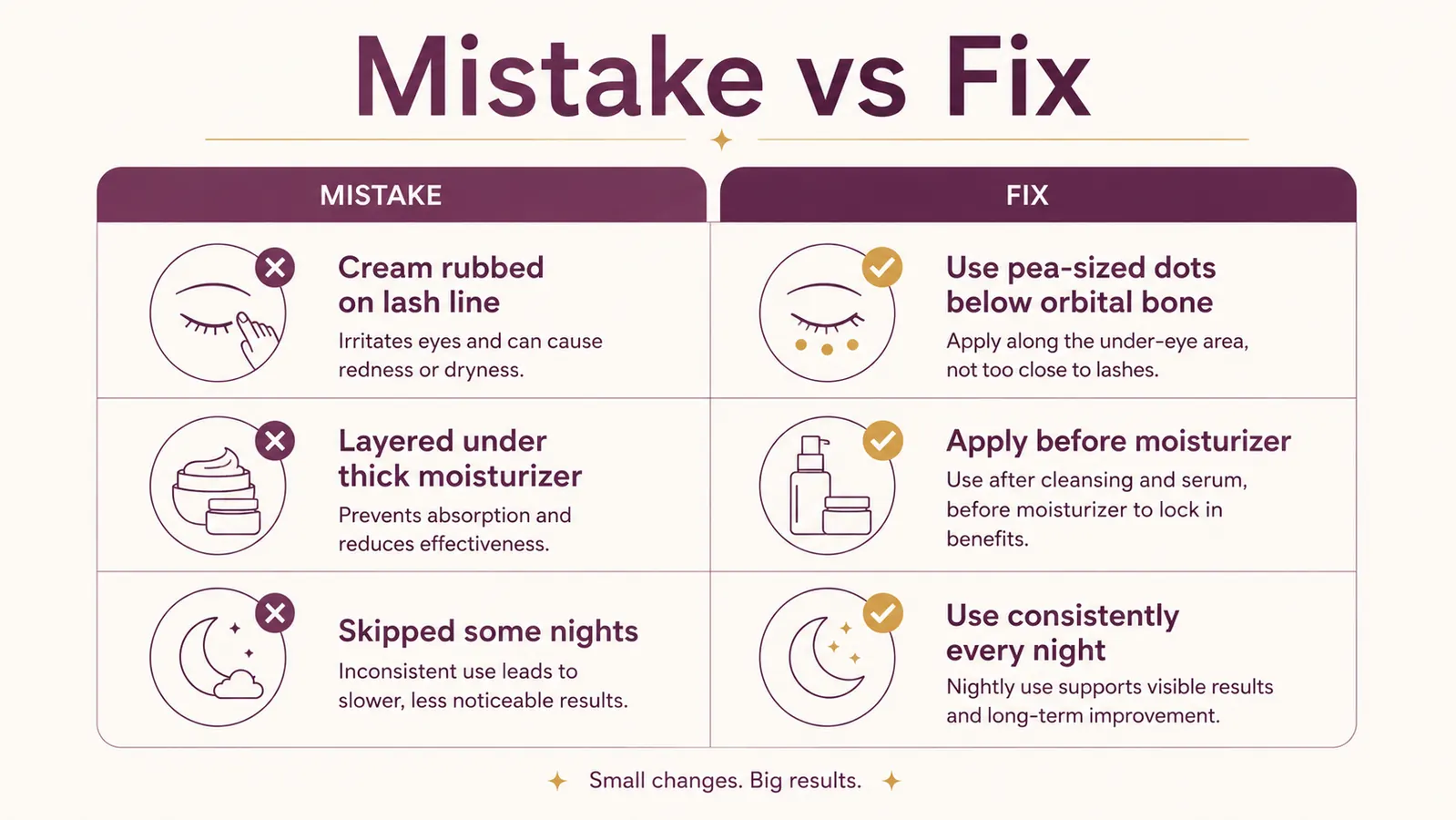
Louise's mistake, the one that nearly ended her RoC jar early, was using a full pea sized dollop for both eyes combined every single night because the jar looked small and she wanted her money's worth. RoC Retinol Correxion needs a rice grain amount total, split between both eyes, patted on with a ring finger. More cream does not speed up results. It just increases your odds of redness, flaking, and the exact irritation that makes people quit in week two.
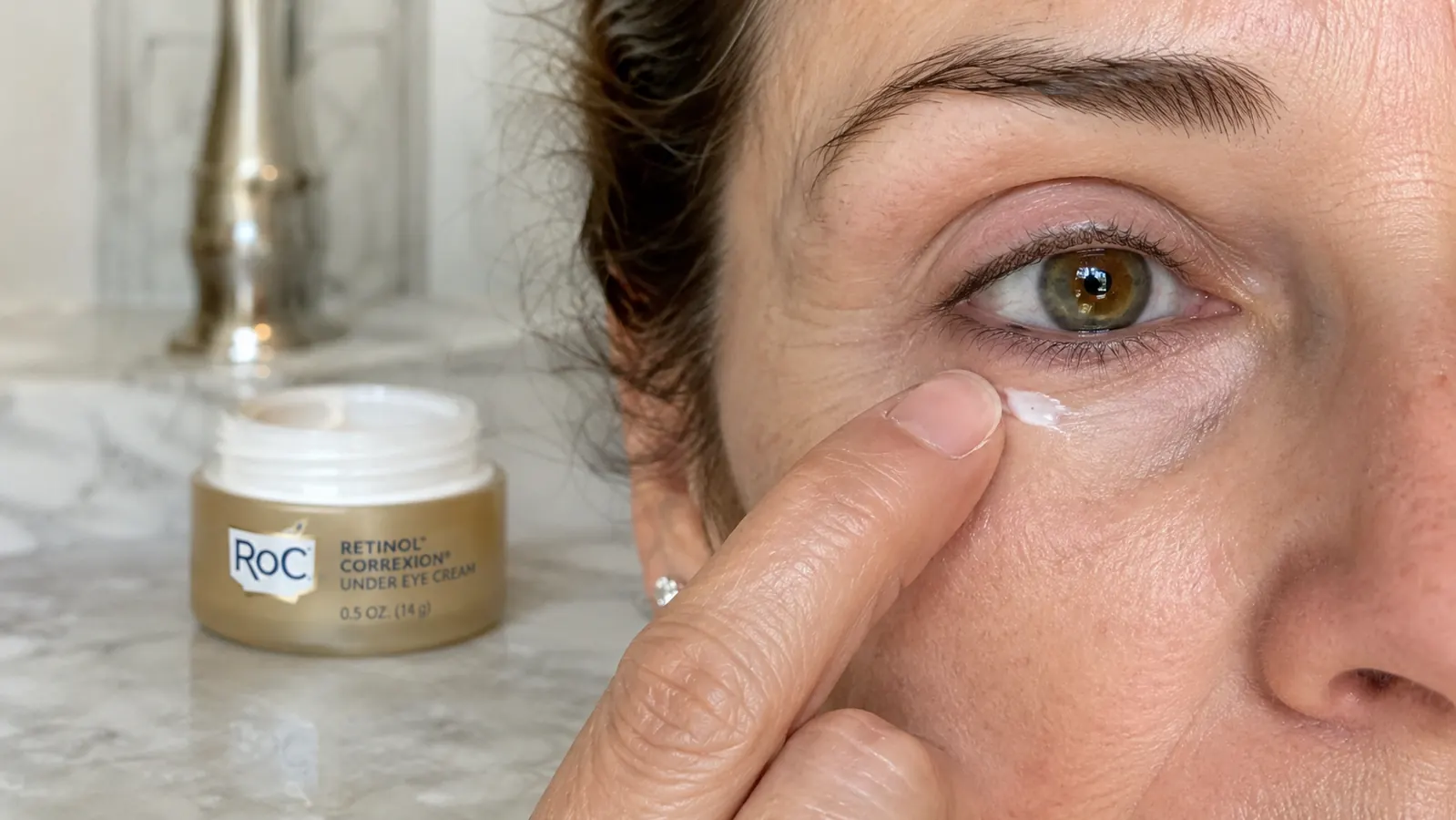
Tanya's mistake was applying RoC directly onto her lash line and even up onto her mobile eyelid, chasing crepey texture that was really outside the cream's intended zone. The formula is meant for the orbital bone area below the lower lash line, not the lid itself and not right up against the waterline. Getting retinol too close to the eye itself is exactly how you end up with stinging, watery eyes and a jar you're afraid to touch again.
The third common mistake is skipping nights the moment any tingle shows up. A mild tingle for the first week or two is normal and expected with a retinol product, and it typically fades once your skin adjusts. Stopping and starting RoC inconsistently, using it three nights on and four nights off out of nerves, is the single most common reason I hear people say it never worked. Consistency, not intensity, is what actually moves the needle with this formula.
A fourth pattern I noticed with Tanya was applying RoC over damp skin straight out of the shower, thinking it would absorb faster. It actually does the opposite. Retinol tends to penetrate more evenly and predictably into fully dry skin, and applying it to damp skin can increase irritation because the product absorbs unevenly and faster than intended into softened, water logged tissue. Pat your face completely dry, wait a full minute, then apply your RoC.
How to Layer RoC With the Rest of Your Routine
Layering is where I get the most confused questions about RoC, and honestly the box does not explain it well. The order that has worked for every client I have walked through this is cleanse, let your face fully dry, apply RoC Retinol Correxion first while the eye area is bare, wait roughly two full minutes for it to absorb, then move on to your regular face moisturizer everywhere except directly over the eye cream. Putting a heavy moisturizer on first and RoC on top just dilutes the retinol and slows down absorption.
If you also use a vitamin C serum in the morning, keep RoC to nighttime only and never apply both around the eyes in the same routine. If you use a separate retinol or retinoid on the rest of your face, do not also layer it over the eye area where you're already using RoC. That is doubling up on the same active ingredient in the thinnest skin you have, and it is the fastest route to irritation I have seen in twenty five years behind the counter.
One more layering detail that trips people up is eye makeup removal timing. If you're using an oil based makeup remover at night, RoC needs to go on after that oil has fully absorbed or been wiped away, not on top of leftover residue. Oil residue creates a barrier that keeps the retinol from reaching the skin at all, which quietly explains a lot of the it never did anything for me reviews I've read over the years.
Sunscreen the next morning is non negotiable if you're using RoC at night. Retinol makes skin somewhat more sun sensitive while it works, and skipping SPF around the eyes undoes a good part of what the cream is trying to build back. Priscilla's biggest improvement after week four had less to do with the RoC itself and more to do with finally wearing sunglasses and a mineral sunscreen every single morning alongside it.
Buying and Storing RoC So the Jar Actually Works
Retinol degrades with light and air exposure over time, which is exactly why RoC ships its Retinol Correxion Under Eye Cream in an opaque jar rather than a clear tube. Keep that lid twisted on tight between uses and store the jar somewhere cool and dry, not on a steamy shower ledge where humidity and heat will shorten its shelf life. A half ounce jar used correctly, a rice grain a night, should last close to two to three months, which tells you something if yours is running out in three weeks.
I always tell clients to check the batch code on the bottom of the jar if they are buying from anywhere other than a trusted retailer, because retinol products are exactly the kind of thing that gets counterfeited or sold well past a reasonable shelf date on secondary marketplaces. Buying from Amazon directly through a listing with current reviews and recent purchase activity is a far safer bet than a flea market table or an unfamiliar third party seller you've never heard of.
Temperature matters too, more than most people expect. I do not recommend leaving a jar of RoC in a hot car during a Georgia summer road trip, or packed in checked luggage sitting on a sweltering tarmac, because heat speeds up the same degradation that light does. If you travel with your jar, keep it in a carry on bag, away from direct sun, and treat it a little like you would treat sunscreen.

What to Actually Expect, and What Nobody Puts in the Ad Copy
RoC will soften the look of shadowing caused by thin skin and visible blood vessels, and it does meaningfully help with mild to moderate puffiness over several weeks of nightly use. What it will not do is erase a deep hollow tear trough caused by volume loss, and it will not touch dark circles that are purely genetic pigmentation passed down from a parent, the kind Louise and I both inherited on our mother's side. No jar at any price fixes bone structure or genetics, and any review that tells you otherwise is selling you something.
The other thing nobody mentions is that RoC works best as part of a boring, repeatable routine rather than a rescue product for a rough morning. If you're hoping to pat some on before a big event and look refreshed in twenty minutes, that is a cooling gel or a caffeine eye roller's job, not a retinol cream's job. RoC is playing a slower, structural game, and expecting it to behave like a quick fix is where a lot of one star reviews come from.
I will also say plainly that RoC is not going to outperform an in office treatment like under eye filler or a prescription strength retinoid for someone dealing with significant volume loss. It is a strong, honest drugstore option, not a replacement for a dermatologist's toolkit. Comparing RoC against those categories is comparing apples to oranges, and it sets the cream up to fail before it ever gets a fair chance.
What I Liked
- Real, stabilized retinol at a genuinely low price point
- Gentle enough formula for daily use once dosage is corrected
- Noticeably softens puffiness and mild dark circle shadowing over 6 to 12 weeks
- Widely available and easy to replace
- Opaque jar packaging protects the retinol from light degradation
Where It Falls Short
- Mild tingling or flaking is common in weeks one and two
- Will not fix deep tear trough hollowing or pure genetic pigmentation
- Easy to overuse if you don't measure the rice grain amount
- Layering instructions are not explained clearly on the packaging
- Results require real patience, this is not a same day fix
The jar never changed between Louise's failed attempt and her successful second try. Her technique did.
Who This Is For
RoC Retinol Correxion is a smart pick for anyone dealing with mild to moderate dark circles caused by thin skin or visible blood vessels, mild under eye puffiness, and early crepey texture, who wants a real retinol without a dermatologist prescription or a department store price tag. It is also a good starter retinol for anyone nervous about trying prescription strength tretinoin around the eyes first, since the encapsulated formula is gentler by design.
Who Should Skip It
If your dark circles come from a deep structural hollow rather than pigmentation or thin skin, or if you have very reactive, easily irritated skin that flares at the mention of retinol, RoC is likely to disappoint or irritate you before it ever helps. Anyone expecting a visible difference inside a week, or looking for an event day quick fix rather than a long term nightly habit, should look at a caffeine based eye serum instead and save RoC for when patience is actually on the table.
Ready to try RoC the right way this time
A rice grain amount, patted below the lash line, applied consistently for six to twelve weeks. That is the whole trick behind every good RoC result I've seen. See today's price and start your own jar tonight.
Amazon Check Today's Price on Amazon →